What To Do With Your Tax Refund?

Congratulations if you happen to be one of the fortunate taxpayers to receive a tax refund this year! The typical refund averages around $3,000, an amount that isn’t exactly chump change, and you’re probably wondering what you should do with all that money.

We suggest that you take the time to evaluate the recommendations below, and then develop a plan for what you’re going to do with your refund.

Before getting started, it’s worth pointing out that the reason you received a refund in the first place is because you overpaid your taxes to the government during the year. In effect, you made an interest free loan to the government for the amount of the refund. In order to avoid making another loan of this sort in the future you can adjust, or lower, the amount of withholdings taken out of your paycheck every pay day and end up at the end of the year at a more break-even level with what you owe.

This being said, some taxpayers want to have something to look forward to in the form of a refund or forced savings that creates the sense of a bonus to look forward to at the end of the year. The following choices assume that the taxpayer likes the forced savings/quasi-bonus approach and doesn’t care to break-even on their taxes.

  • Set up an emergency fund to help get through those rough times when an unexpected emergency situation arises. Establish an emergency fund by depositing all, or a part, of the refund into an interest bearing savings or money market account that permits easy access to your money when the emergency arises.

  • Pay off debt. Some experts recommend that after establishing an emergency fund, the next best thing you can do with your tax refund is to reduce or eliminate any high-interest debt that you’re carrying. Put your refund to work by paying down debt that carries interest at a rate that is greater than what you can earn in interest elsewhere. The trade-off between eliminating high interest debt with low interest earning investments is literally a moneymaking proposition.

  • Don’t just deposit the refund into a non-interest bearing checking account and let it sit there for “safe keeping.” In this scenario the refund is sitting idle not earning at least some interest. Deposit the refund into an interest bearing savings account or money market account that permits easy access to the funds as needed.

  • Loan the funds to friends or family with the expectation that the loan will be repaid. Of course, with all due respect to friends and family, making loans to them is a high-risk proposition. These sorts of loans seem to have a higher risk of not being repaid. If the risk of not being repaid is something you can live with then proceed with making the loan. However, if you are counting on the loan being eventually repaid and you need to have the funds then do not make the loan.

  • As noted here, start an individual stock investment account. This is a good way to get very familiar with the stock market and individual stock investing, Start small. Perhaps invest some amount that is less than your total refund. This kind of investing carries substantial risk, but has the potential for substantial reward.

  • Start that business you’ve always dreamed about. As Kiplinger notes, with the average rate of $3,000 per refund, it might be possible to cover those start-up costs that will put you over the threshold that needs to be incurred to get that business started. Very successful businesses have been started in garages and home offices for far less of an investment.

  • Treat yourself to a vacation. There’s nothing wrong with using your refund to do something really special that you’ve only dreamed about doing. $3,000 can go a long way toward paying for a vacation to some exotic destination, someplace special, without having to go in debt to pay for it. It’s called being good to yourself. Think of it as a vacation paid for by Uncle Sam! But make it really special and do it before you spend your money on unnecessary day-to-day operating expenses, which will always be there.

  • Make an extra payment on a student loan. It seems like amounts owed on student loans will never go away. These loans typically carry interest rates that are at the high end of the interest rate spectrum so that making an extra payment is not only a profitable strategy but will help get rid of these loans sooner.  

  • Contribute to an IRA. It doesn’t hurt to fund next year’s IRA contribution sooner rather than later so why not do it now and then forget about it next year when tax time is upon us. It’s almost like experiencing the sense of a “free contribution” because the contribution is being funded with a tax refund, even though the refund was from your own money in the first place.

Category:

What’s the Difference Between a Lease and an Outright Purchase When Acquiring a Car?

Over the last several years there has been increased popularity and attention given to “leasing” as a financing alternative over the outright purchase alternative when acquiring an automobile.

There’s no question that leasing offers some significant benefits over an outright purchase, otherwise it wouldn’t be so popular. This blog, however, is intended to be a wake-up call for those who don’t fully comprehend some of the negative aspects and consequences of leasing a car instead of purchasing a car outright.

Probably the most obvious benefit of a lease is that the cash out for down payment (or what’s referred to as “what’s due at initial lease signing” in lease jargon) and the monthly payments is significantly less than what the monthly payments and down payment would be when using the purchase-financing alternative.

There’s an explanation for why total cash out under the lease scenario is less than total cash out under the purchase scenario. Under the lease scenario the purchaser (lessee) makes payments to merely “rent” the car -- at no point in time during the lease term does the purchaser take title to the car. The lessee acquires the right to use, not own, the vehicle in return for the monthly payments that he or she makes to the seller. Under the lease scenario the lessee’s payments are just sufficient to “reimburse” the lessor for the car’s depreciation, which is less than what it would take to payoff the amount of “principal.”

On the other hand, under the purchase scenario the buyer pays a higher monthly payment because the payments have to be sufficient to payoff more than just depreciation so that the buyer can take title to the car by the time the last payment is made to the seller.

Does a lease make sense for you? The size of the monthly payments is only one of several factors that need to be weighed when considering taking out a lease. The answer to the question of whether or not an auto lease is right for you is very much dependent on a mix of personal factors.

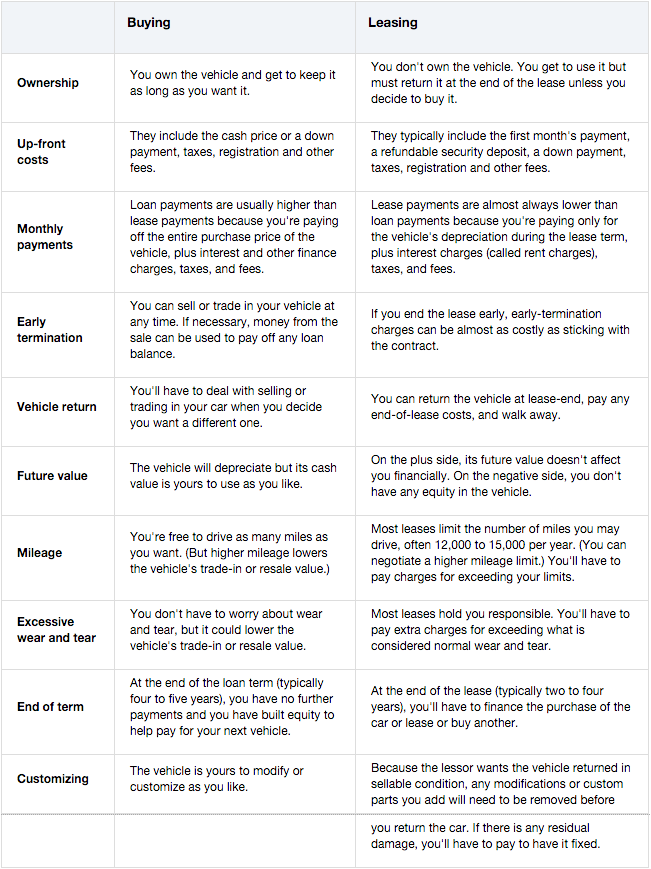
The following table, which compares the purchase and lease financing choices, is made available by Consumer Reports:

consumer reports table

If you think you might want to pursue a car purchase by using lease financing then check out the Wall Street Journal article at How to Lease a Car and Get the Best Deal.

A potential benefit from leasing is what happens when the residual value of the car at the end of the lease is dramatically less than what the market value of the car is worth. In such cases the lessee/buyer can get an outrageously good deal by paying off the residual value and keeping the car.   

Happy trails with your new car!

Category:

Off to School

It’s that time of year; students are headed back to school and we are once again reminded that another year of the educational timeline has begun.

For parents,  it only gets more expensive as the years tick by and approach the most expensive time of our educational years; college. As in many other aspects of our lives,  the best way to confront this challenge is by being prepared.

A common way to save for your child’s future educational expenses is a 529 plan. There are various types of 529 plans available and they differ in each state, but generally a 529 plan is a way to save for a child’s education tax-free. The gains on 529 plans are tax-free when the funds from a 529 are used to pay tuition expenses. While 529s are flexible in that if your child decides not to go to college the beneficiary can be changed, the funds must be used for educational expenses including tuition, room and board, books, fees and supplies.

529s also cover one of the biggest mistakes a parent can make in saving for their child’s education, saving money in the wrong person’s name. A federal formula decides how much financial aid a student receives and in this formula there are protections in place for assets in a parent’s name that do not exist in the case of the same funds being in a student’s name. That means that if there is $10.000.00  in a student’s savings account,  the student’s expected contributions could be up to 20% while the same amount of money in a parent’s account could be as low as 6%.

Your accountant can help your decide what kind of college savings account is best for you and your financial needs.

Category:

Never an Endless Summer

The end of summer is in sight and for the younger members of the population, that means coming to grip with the end of worry free summer days. As the school buses take to the streets, the back to school sales heat up and the weather begins to cool down, you might want to take this opportunity to evaluate where your finances stand.  

The end of summer doesn’t just mean it’s time to start packing lunches - it’s a good time to re-evaluate your finances and prepare for the new season, and maybe even get a head start on the new year.

  1. Adjust. The end of summer means different things to different budgets, maybe you are going to be driving less, maybe more. Regardless, this means adjusting your budget to ensure that you are prepared and have your money in the right place..

  2. Be prepared. Labor day is nearly here, Halloween decorations are coming to the stores, then Thanksgiving and on it goes… Get your budget ready for the costs associated with the holiday season - like gifts and travel. You don’t want November and December to come around and realize you don’t have the money set aside for these expenses.

  3. Review. Summer can be an expensive season with vacations, events, road trips, backyard BBQs, etc. Maybe you spent more than you had planned, so it's a good time to replenish those emergency funds that you should have set aside for unexpected costs such as winter car repairs, flu season, or any other emergency.

  4. Plan ahead. It’s about time you started thinking about 2016. Before you can tackle a new year you should take a little time to make sure you have everything from 2015 in order.

Category:

Rising Costs in 2015

Your guide to goods and services expected to increase in price in 2015.

Abraham Lincoln once said, “The best way to predict the future is to create it.” Budgeting and being organized with your money is the foundation for creating more money.

This year, 2015 brings with it rising costs that could negatively impact your budget if you’re not prepared. Here’s a list of what’s going to get more expensive this year:

  • Food & Drink: With droughts in California, agricultural development has been impaired which has also impacted beef and pork livestock.  A drought in Brazil has resulted in less supply which is raising the cost of coffee. Bourbon is becoming a much more popular beverage and is used more in more in cooking recipes as well. And since, it takes years to make, there’s simply not enough to meet demand. Chocolate is also supposed to rise in cost due to higher demand.

  • Travel: Folks are traveling again. This means there are fewer flights with empty seats and empty seats are what drives deals with airlines. With fuel prices being much lower than they have been in a long time, airlines don’t seem to be dropping any fees they added when fuel rose in 2008. Additionally, Hotels are expected to increase rates by a little over 2%.

  • Debt: The Federal Reserve is doing away with a mechanism they put into place during the 2008 financial crisis to stimulate the economy. This will likely result in higher rates on interests.

  • Health Care: Costs for health care is expected to increase by almost 7% next year. It’s projected that many employers will raise deductibles and/or have employees pay more out of their paychecks.

  • Shipping: USPS has not announced an increase in postage for 2015 although, FedEx and UPS both have announced an increase. Also, online companies have been raising minimums on purchases for free-shipping as well as charging more for subscriptions that include free shipping.

  • Electricity: Many utilities across the US are planning on the steepest increases since 2008.

Category:

Industry-Leading Affordability and Value at Every Level

See All Features Buy Now